In the first week of 2026 alone, four Nashville restaurants closed their doors for good. A recent Instagram post from The Tennessean said 73% of the restaurants and coffee shops that have closed in Nashville this year were locally owned. Of the new openings in 2026, only two are locally owned businesses.
I've been watching this happen for eight years from the ground level. As the founder of A Little Local Flavor, Nashville's highest rated food tour, I've walked 24,000 people through locally owned restaurants in this city and invested $1.4 million directly into those businesses. I've also watched seven of my own restaurant partners close.
This isn't a trend I'm reading about. It's something I live every time I take guests downtown and give local recommendations.
How Nashville's Local Restaurant Scene Started Disappearing
When I opened A Little Local Flavor in 2018, roughly 80% of the restaurants and bars in downtown Nashville were locally owned. Today that number has flipped to about 20%.
The shift accelerated fast, starting right around 2018 when the celebrity-branded bars began arriving in force. Jason Aldean. Luke Bryan. Blake Shelton. One after another, music stars and their investment groups came to Broadway and offered rents that local business owners simply could not match.
Broadway was already Nashville's most valuable corridor. But when celebrity bar money entered the picture, property values and the rents attached to them reached a level that most locally owned businesses couldn't sustain. The businesses that had built Broadway into what it was got priced off the street they helped create.
Now roughly 80% of Broadway's bars and venues are not locally owned. The profits from your bachelorette weekend, your corporate outing, your spontaneous Tuesday night out, most of that money is leaving Nashville.
The Triple Net Lease Problem Pushing Nashville Restaurants Out
Here is something that does not get enough attention in this conversation. Most commercial tenants in downtown Nashville operate under what is called a triple-net lease, often written NNN. The tenant pays three things on top of rent: property taxes, building insurance, and maintenance. The landlord owns the building, collects rent, and passes every other cost, including any tax increase no matter how dramatic, straight through to the tenant. The tenant has no equity in the property. They can't sell it. They can't borrow against it. They can't profit when the building's value goes up. They can only operate inside it and pay every bill that comes with it.
Triple-net leases are standard on Lower Broadway. Roughly half of the 37 businesses in the Broadway Entertainment Association are on them. It's the structure that lets a building owner sit back and collect rent on rapidly appreciating real estate while their tenants absorb every cost increase the city assigns to that property. When a building gets reassessed at four times its previous value, the landlord celebrates. The tenant gets a tax bill that may exceed their entire net profit.
It's the property tax portion of the NNN that has become catastrophic.
Acme Feed and Seed, one of Nashville's most iconic venues and a flagship Broadway bar and restaurant credited with helping revive Lower Broadway when it opened in 2014, is one of my restaurant partners. Their property tax bill went from $129,000 a year to $600,000 a year in a single year.
What Acme Feed and Seed Owner Tom Morales Said About Nashville's Property Tax Crisis
Tom Morales put it plainly in a letter to Nashville Mayor Freddie O'Connell that he later posted publicly: "It went from $129,000 a year to $600,000 a year. That's more than our rent and net profit combined. We can't pay it. It's punitive."
Morales also wrote that he has spent much of his life "working to preserve the soul of Nashville by promoting its hospitality and creativity," and described the situation facing small business owners as being "squeezed out by policies that seem to favor large corporations." He has been key in preserving iconic landmarks such as the Loveless Cafe, The Woolworth, and Acme Feed and Seed.
What the Mayor Got Wrong
FOX 17's Dennis Ferrier asked Mayor O'Connell about Acme's property tax increase and Tom's request for a meeting. The mayor's response:
Then Ferrier corrected him in real time:
The mayor of Nashville did not know, or did not register, that Tom Morales doesn't own the Acme Feed and Seed building. Tom operates on a triple-net lease. The building belongs to Lester Turner and Currey Thornton.
That is exactly what happened to Acme. The whole point of Tom's letter to the mayor was that the tax hike on a building he doesn't own is bigger than his rent and net profit combined.
The mayor's advice, that Tom should "capture the value that's inherent in the property," assumes Tom can sell the property. He can't. The "significant offers" the mayor referenced are offers to buy the building from the actual owners, not from Tom. If those owners sell, Tom doesn't get a windfall. He gets evicted.
Even after being corrected on camera, the mayor kept going:
In other words: small businesses are sentimental. Markets are real. Sorry.
Sometimes beloved old businesses close. That is what the mayor of Nashville said about a 14-year-old anchor of Lower Broadway, owned by a man who launched Dancin' in the District in 1994, when Lower Broadway was full of pawnshops and porn shops. Dancin' is formally credited with helping recruit the Titans and the Predators to Nashville. Tom Morales doesn't just operate on Lower Broadway. He created the value that the city is now taxing him out of. This was the mayor's response after being told on camera that the man he was talking about doesn't own the building.
No business plan can absorb a $471,000 tax increase in a single year, that’s nearly $42,000 a month in increased taxes. Here is the part that makes it especially painful, these business owners cannot tap into the equity of the property to cover it, because it is not their property. They have no equity to borrow against. They carry the financial exposure of ownership without any of the ownership upside.
Acme has started a local beer campaign to help raise the property tax money. They have $3 beers all day every day. Stop by and drink one, or three.
Layla's Honky Tonk: The Only Female-Owned Bar on Broadway
Layla's is the only female-owned bar on Broadway. Owner Layla Vartanian has been running it since 1997 and has said publicly: "I've never seen an increase of any kind of property tax or any kind of tax in such a short period of time. We're having an increase of 300-400% on these buildings down here."
As another female business owner, I cannot overstate how significant this is. We are talking about a business generating millions in revenue, built and owned by a woman, in an industry where female ownership at that scale is genuinely rare. And it is at risk of closing not because of anything the owner did wrong, but because of a tax bill she has no ability to control.
Layla has said her bar will not survive without reform.
The Nashville Restaurants That Became Victims of Their Own Success
What makes this story genuinely painful is that the restaurants being pushed out are not failing businesses. They are beloved, highly rated places that invested in their neighborhoods before anyone else did. They made those neighborhoods desirable, and then got priced out of the neighborhoods they built.
Fido in Hillsboro Village
Fido has been a Nashville staple since 1996. Founder Bob Bernstein announced in October 2025 that the beloved Hillsboro Village coffee shop would close on June 1, 2028, giving his community nearly three years' notice because, as he put it, he didn't want the closing to be a sudden sad thing.
In his announcement, posted inside the restaurant alongside a countdown clock, Bernstein described exactly what has happened to locally owned Nashville businesses:
He also told reporters: "People think small businesses must be booming because the city is booming. But it's not the case." And: "To start a small business, for somebody to do what I did 30-something years ago, would be very difficult today. Somebody with no experience, little to no resources, no credit history, no anything. That would be near impossible to do again."
I had breakfast at Fido the morning I moved into my first house in Nashville. It holds a lot of memories for a lot of people in this city. That it is closing because of economics rather than anything wrong with the business or the food is a hard thing to sit with.
Margot Cafe and Bar, East Nashville
Margot McCormack opened Margot Cafe and Bar on June 5, 2001, in a former gas station on Woodland Street in East Nashville's Five Points neighborhood. She turned it into one of Nashville's most acclaimed restaurants, earning four James Beard nominations and national coverage in The New York Times, TIME, and The Wall Street Journal.
She announced in November 2025 that June 5, 2026, exactly 25 years to the day after opening, will be the restaurant's last day of service.
In her farewell statement, McCormack wrote: "We have survived 9/11, the recession of 2008, a flood, the influx of so many new restaurants, a tornado, COVID, and so much more. The last five years have been harder than the first 20 put together. I am that much older and wiser and don't have much more fight in me."
She survived everything Nashville threw at her over a quarter century. And yet the last five years, the years after COVID, the years of explosive growth and skyrocketing costs, were harder than all of it combined.
Pelican & Pig and Slow Hand Coffee + Bakeshop, East Nashville
Nick and Audra Guidry opened Pelican & Pig on Gallatin Avenue in 2019 and turned it into one of East Nashville's most beloved restaurants, named Eater's Restaurant of the Year in their first year and later featured on Netflix's Somebody Feed Phil. They added Slow Hand Coffee + Bakeshop next door so the same neighborhood block had two reasons to come back the next morning.
In March 2026, the Guidrys announced that both businesses would close on March 14 after seven years, citing the same property tax pressure dismantling the rest of the city's independent food scene. "Incredibly expensive to operate in this city," Nick told WSMV.
You can still find their food, just not in East Nashville. The Guidrys live in Lebanon and have been quietly building a Wilson County food empire for years: Slow Hand Bakehouse and Olivia Craft Cocktail and Oyster Bar in Lebanon, plus Leon's Famous Deli in Mt. Juliet. The bakery operation that fed Pelican & Pig and 30+ wholesale accounts in Nashville continues out of Lebanon. Drive 30 minutes east and the pastries are still there.
Worth noting: the Guidrys didn't leave Nashville because Nashville stopped working. They left because operating inside the city stopped working. The same neighborhood that made Pelican & Pig a destination is the neighborhood that made it impossible to keep running.
Jane's Hideaway, East Nashville
Jane's Hideaway was my favorite spot in downtown Nashville from the day it opened. The owner, John Pete, ran a remarkable restaurant that won best new restaurant by popular vote in the Nashville Scene the year it opened. I was there probably four nights a week. It was my version of Cheers.
When his rent increased to an unsustainable level at the end of his lease, John found a new space in East Nashville. He built out a kitchen from scratch in a building that had never had one. He rebuilt.
Three years into the East Nashville location, the building sold. New owners. New rent. Same impossible math.
These are not restaurants that failed. They are 4.6 and 4.7 star restaurants on Google. They are places that people traveled to Nashville specifically to visit. They didn't close because the food wasn't good enough or the business wasn't run well. They closed because the economics of operating in a fast-growing city caught up with them in ways they couldn't survive.
Why Losing Locally Owned Nashville Restaurants Hurts the Whole City
I understand this can sound like a local business owner lamenting change. But there is a real economic argument here that matters for Nashville as a city.
Tourism is one of Nashville's largest industries. Between sales tax, alcohol by the drink tax, occupancy tax, and the higher sales tax rates in the tourist corridor, a significant portion of our city's tax base flows through restaurants and hospitality.
When that money flows through a locally owned restaurant, the profits stay here. The owner pays property taxes with those profits, property taxes that fund our schools. They spend those profits at other Nashville businesses. They hire Nashville residents. That money circulates through our community.
When those profits flow to an investment group headquartered in another city, a significant portion of that economic activity goes with them. Multiply that across 80% of Broadway's venues and you start to understand the scale of what we are looking at.
The narrative that Nashville is booming is real in some ways. But talk to people who actually work downtown, and a different picture emerges. Tourism is not what it was three and four years ago. For many of us, traffic is slower than it was before COVID. The boom is real, but it is not evenly distributed, and it is not without cost.
How A Little Local Flavor Invests in Nashville's Local Restaurant Scene
I started A Little Local Flavor in 2018 with a goal I didn't say out loud for almost two years because it felt too big: what if I could put $1 million into locally owned Nashville restaurants? I thought it would take at least ten years.
We did it in five.
We have now invested $1.4 million into locally owned businesses. That is just what we have spent directly on food and beverage on the tours themselves, not counting what our guests go back and spend on their own. And we have walked 24,000 people through the doors of those restaurants, telling their stories, explaining their menus, and making the case for why it matters where your money goes when you travel.
Even that was not enough to keep all of them open. In eight years, I have watched seven of my restaurant partners close: Merchants, The Woolworth on 5th, Poncho and Lefty's, Cerveza Jack's, The George Jones Museum, Music City Chicken, and Jane's Hideaway. These were not restaurants that ended up on our tour by accident. They were locally owned, highly rated, and doing exceptional work. They couldn't survive anyway.
That is a hard thing to carry. But it also makes the work feel more urgent, not less.
How to Support Locally Owned Nashville Restaurants When You Visit
When you visit Nashville, every dollar you spend is a vote for what this city becomes. Here is how to make it count.
Eat and drink outside of Broadway when you can. The neighborhoods , East Nashville, Germantown, 12 South, Hillsboro Village, The Nations, are where you will find the best locally owned restaurants right now, and where your money has the most direct impact.
Ask your bartender where they actually go. Don't ask what tourists should do. Ask where they take their friends, what their favorite restaurant is, what bar is their spot. That question gets you a completely different answer and a much better experience.
Look for locally owned restaurants when you eat in downtown Nashville. It is not always obvious, but it is worth asking. Many Nashville restaurants are proud to be local and will tell you. Some of my favorites are: D’Andrew’s Bakery, Etch, Acme Feed and Seed, The Farm House, Black Rabbit, The Southern Steak and Oyster, Fleet Street Pub, and Broadway Brewhouse.
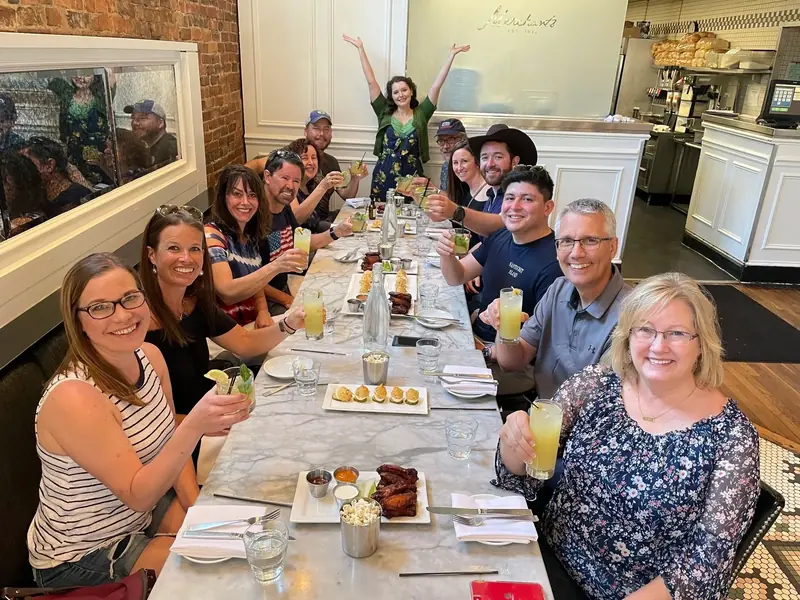
Come on a food tour. Our downtown Nashville food tour takes you to the best locally owned restaurants in the heart of Music City. We tell you their stories, serve the best dish on their menus, and make sure your money stays in our city. Every ticket goes directly back into locally owned Nashville businesses. We also offer private and corporate group tours for groups of any size.
Nashville's food scene is worth fighting for. The restaurants that built this city's reputation and made Nashville a place worth visiting are exactly the ones most at risk right now. They need you to show up.
We will keep doing our part. We hope you will do yours.
Christine is the founder of A Little Local Flavor, Nashville's highest rated food tour with 2,800+ five-star reviews and a Top 1% TripAdvisor ranking. She has hosted 24,000+ guests and invested $1.4 million directly into locally owned Nashville restaurants over eight years.

You've come all the way to Nashville.Eat like it.
Our downtown Nashville food tour is the #1 rated culinary experience in the city, with 2,800+ five-star reviews.
Three hours, six stops, live music.